Getting shortlisted for an interview is one thing. Turning that opportunity into an offer is another.
You may have the right experience but struggle to communicate it effectively during an interview. Perhaps you are changing companies, targeting a managerial position, moving into a new function or preparing for a more senior corporate role.
At 7Skyee, our Interview Coaching Service helps professionals prepare for interviews with a practical, role-focused approach.
With 17+ years of recruitment experience, we understand what recruiters and hiring managers look for—and how candidates can communicate their experience more effectively.
Interview Preparation for Gurgaon, Gurugram and the Wider NCR Market
Gurgaon, officially Gurugram, has a highly competitive corporate employment environment.
Candidates may be interviewing for roles across:
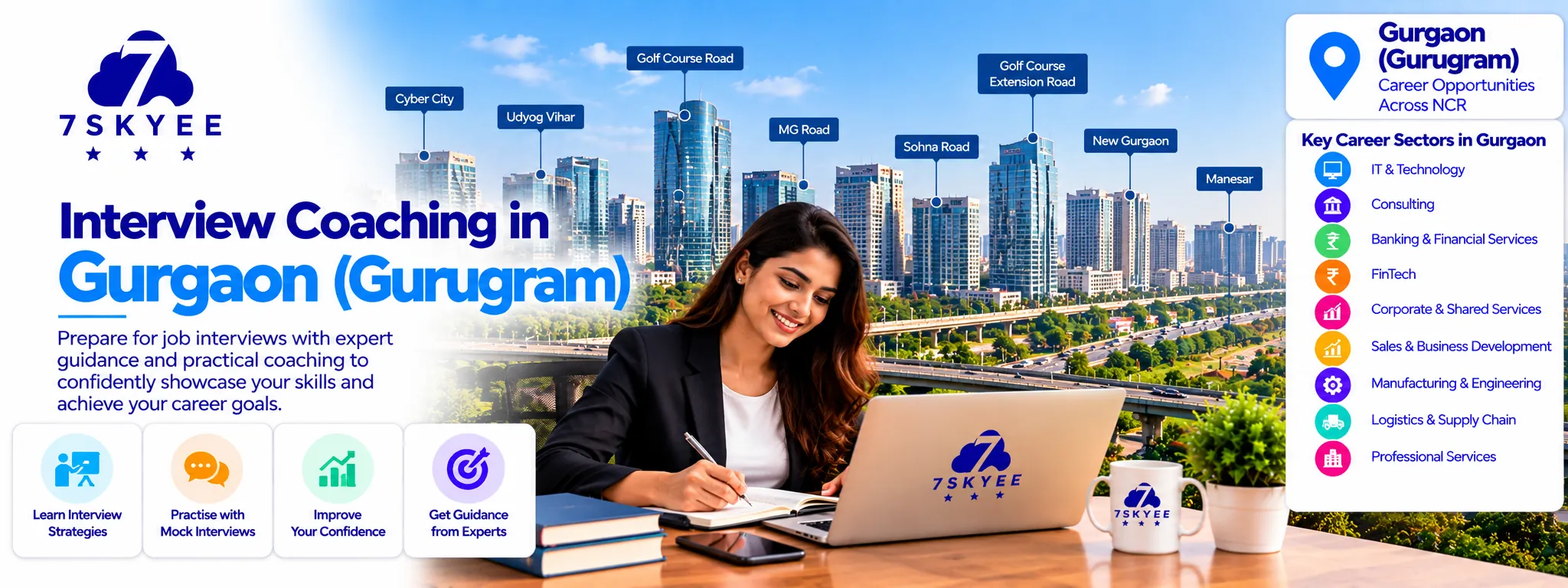
Cyber City
Udyog Vihar
Golf Course Road
Golf Course Extension Road
MG Road
Sohna Road
New Gurgaon
Manesar
The wider NCR market also creates opportunities in:
Delhi
Noida
Greater Noida
Faridabad
Ghaziabad
An interview for a technology role can be very different from one for consulting, banking, sales, finance or corporate operations.
That is why effective preparation should be based on your target role and career level, rather than a generic list of interview questions.
Getting Interviews but Not Getting Offers?
If you are receiving interview calls but not converting them into offers, your qualifications may not be the problem.
The issue may be how you present your experience.
Common problems include:
Giving lengthy or unfocused answers
Struggling with “Tell me about yourself”
Describing responsibilities instead of achievements
Not connecting your experience to the target role
Giving weak behavioural examples
Becoming nervous during follow-up questions
Struggling with senior-level questions
Not explaining frequent job changes properly
Finding career-change questions difficult
Handling salary discussions poorly
Not asking meaningful questions at the end
Interview coaching helps you identify these weaknesses before they affect another opportunity.
“Tell Me About Yourself” — Get Your Opening Right
Your introduction often shapes the first impression.
Many candidates simply repeat their resume.
A stronger introduction should communicate:
Who you are professionally
What experience you bring
What you do particularly well
Why your background is relevant to this position
Your answer should be concise, confident and aligned with the role you are targeting.
Interview Coaching for Gurgaon and Gurugram's Major Career Sectors
Different industries require different preparation.
IT and Technology
Technology interviews may involve technical, behavioural and managerial discussions.
You may need to prepare for:
Technical questions
Project experience
Problem-solving
Technology decisions
Client management
Stakeholder management
Leadership
Behavioural questions
Your examples should demonstrate what you actually did and what resulted from your decisions.
Consulting and Professional Services
Consulting interviews often assess structured thinking as well as professional experience.
You may encounter questions around:
Problem-solving
Business situations
Client management
Analytical thinking
Communication
Project delivery
Leadership
Senior candidates may also be expected to discuss business impact and strategic thinking.
Banking and Financial Services
Finance interviews can cover:
Financial analysis
Banking
Risk
Compliance
Corporate finance
Investment
Client management
Business situations
Candidates should be prepared to explain how they have applied their knowledge in real situations.
FinTech
FinTech interviews can combine financial knowledge with technology, product or business capabilities.
Depending on the role, you may need to discuss:
Products
Technology
Customer experience
Data
Risk
Operations
Business growth
Corporate and Shared Services
Gurgaon has a substantial corporate and shared-services ecosystem.
Professionals may interview for roles across:
Finance
Human Resources
Procurement
Operations
Legal
Administration
Customer operations
Global business services
Interview preparation should focus on measurable contribution, process improvement and stakeholder management.
Sales and Business Development
Sales interviews often require evidence of commercial performance.
You may be asked about:
Revenue
Targets
New business
Key accounts
Client acquisition
Territory development
Negotiation
Sales leadership
Use specific examples and measurable outcomes wherever possible.
Manufacturing and Engineering
The wider Gurgaon-Manesar region also creates opportunities in manufacturing and engineering.
Interviews may cover:
Production
Quality
Engineering
Maintenance
Operations
Project management
Supply chain
Cost reduction
Preparing for Different Types of Interviews
HR Interviews
HR discussions may cover:
Career history
Motivation
Strengths
Weaknesses
Career goals
Job changes
Compensation
Culture fit
Technical Interviews
Technical interviews assess your professional knowledge and ability to apply it.
Preparation should be based on the actual technology, discipline or function involved.
Behavioural Interviews
You may be asked:
Tell me about a difficult situation.
Describe a time you made a mistake.
Tell me about a workplace conflict.
Give an example of when you led a team.
Describe a difficult problem you solved.
A strong answer should explain the situation, your action and the outcome.
Managerial Interviews
Managers are assessed on more than technical knowledge.
Prepare examples around:
Leadership
Delegation
Conflict management
Performance management
Decision-making
Stakeholder management
Business results
Executive Interviews
At senior levels, the discussion can become much more strategic.
You may be asked about:
Business growth
Transformation
P&L
Strategy
Organisational change
Market expansion
Leadership
Executive decision-making
Panel Interviews
When several interviewers are involved, you need to communicate clearly while remaining engaged with the entire panel.
Virtual Interviews
Online interviews require attention to:
Camera positioning
Audio
Background
Eye contact
Body language
Screen distractions
Internet reliability
Mock Interviews: Practise Before the Real Interview
Knowing the right answer is different from being able to communicate it naturally under pressure.
A mock interview can help you practise:
Your professional introduction
Role-specific questions
Behavioural questions
Difficult questions
Follow-up questions
Salary discussions
Questions for the interviewer
The objective is not to memorise scripted answers.
It is to become more comfortable thinking, structuring and communicating under pressure.
How Should You Answer Behavioural Questions?
A useful structure is:
Situation → Action → Result
Briefly explain the situation.
Then explain what you personally did.
Finally, explain the result.
For example, instead of simply saying:
“I handled a difficult client.”
explain what made the situation difficult, what action you took and what changed because of your intervention.
This gives the interviewer evidence rather than a general statement.
Difficult Interview Questions
Some questions are challenging because there is no single perfect answer.
Why are you leaving your current company?
Keep your answer professional and avoid unnecessary criticism of your current employer.
Why should we hire you?
Connect your strongest capabilities directly to the requirements of the role.
What is your biggest weakness?
Choose something genuine but manageable and explain how you are working on it.
Why have you changed jobs frequently?
Explain the career logic behind your moves rather than becoming defensive.
Why should we consider you after a career gap?
Focus on your relevant experience, current capabilities and readiness to return.
Why are you changing careers?
Explain why the transition makes sense and highlight your transferable skills.
Interview Coaching for Different Career Stages
Freshers
Freshers often worry that they do not have enough experience.
Preparation can focus on:
Self-introduction
Education
Projects
Internships
Strengths
Career goals
Basic behavioural questions
First-job expectations
You do not need to pretend to have experience.
You need to communicate your potential, preparation and willingness to learn.
Experienced Professionals
Experienced candidates need to demonstrate more than knowledge.
Your answers should show:
Achievements
Problem-solving
Professional judgement
Career progression
Business contribution
Relevant expertise
Managers
Managerial interviews require stronger leadership examples.
Prepare to discuss:
Team performance
Difficult employees
Delegation
Conflict
Business results
Stakeholder management
Decision-making
Senior Professionals and Executives
Senior interviews often become strategic conversations.
You may need to discuss:
Business growth
Transformation
P&L
Leadership
Strategy
Organisational change
Market expansion
Executive decision-making
Interview Preparation for Career Changers
A career change creates additional questions.
You may be asked:
Why are you changing your career?
Why should we consider someone from another industry?
Why are you moving into a different role?
How does your previous experience apply here?
The key is to make the connection between your previous experience and the new role clear.
Your answer should demonstrate that the transition is deliberate and considered.
If your resume also needs to reflect the new direction, explore Resume Writing in Gurgaon.
Handling Salary Discussions
Salary discussions can become uncomfortable if you are not prepared.
Before the conversation, understand:
Your current compensation
Your expected compensation
The value of the role
Your relevant experience
The overall opportunity
Other components of the compensation package
Avoid making compensation the centre of the entire interview.
First demonstrate why you are a strong candidate.
Then approach salary professionally.
Interview Preparation After a Career Break
If you have a career gap, prepare for the question rather than hoping it will not come up.
Your response should be:
Honest
Brief
Professional
Forward-looking
Explain the gap without allowing it to dominate the interview.
Then bring the discussion back to your current capabilities and readiness for the role.
What Happens During Interview Coaching?
Our approach is based on your actual career situation rather than a generic question list.
Depending on your needs, preparation may cover:
Your Target Role
Understand what the interviewer is likely to evaluate.
Your Professional Story
Build a clear and credible introduction.
Likely Questions
Prepare for questions based on your experience and target position.
Answer Structure
Learn how to make answers concise, relevant and evidence-based.
Behavioural Preparation
Develop examples that demonstrate your capabilities.
Difficult Questions
Prepare for career gaps, job changes, salary, weaknesses and career transitions.
Mock Interview
Practise under realistic interview conditions.
Feedback
Identify areas where your communication, structure or confidence can improve.
What Makes 7Skyee Interview Coaching Different?
7Skyee brings 17+ years of recruitment experience to career services.
Interview preparation is not about memorising hundreds of questions.
It is about understanding:
What the interviewer is trying to assess
Which parts of your experience matter
How to structure your answers
Which achievements should be highlighted
How to handle difficult questions
How to communicate with greater confidence
The objective is simple:
Prepare better. Communicate clearly. Interview with confidence.
Your Resume and Interview Need to Tell the Same Story
Your resume creates the initial professional picture.
Your interview should reinforce that picture.
For example, if your resume highlights leadership, your interview should include credible examples of:
Leading teams
Solving problems
Improving performance
Managing stakeholders
Delivering results
If you need to improve your resume first, explore Resume Writing in Gurgaon.
Interview Coaching and Your Next Career Move
The career journey often looks like:
Career Direction → Resume → Application → Shortlisting → Interview → Offer
If you need help deciding your career direction, explore Career Counselling.
If you want dedicated recruitment support, explore our Personal Recruiter Service.
Explore 7Skyee Interview Coaching
If you have an interview coming up—or you have been getting interviews but struggling to convert them into offers—professional preparation can help you approach the process with greater clarity and confidence.
Explore the complete 7Skyee Interview Coaching Service.
Career Resources for Gurgaon and Gurugram
Your interview is only one part of your job search.
Resume Writing in Gurgaon — Build an ATS-friendly resume aligned with your target role.
Resume Writing Services — Explore the complete professional resume writing service.
Career Counselling — Get guidance when you need clarity about your career direction.
Personal Recruiter — Explore dedicated recruitment support for your job search.
Jobs in Gurgaon — Explore relevant opportunities across Gurgaon, Gurugram and the wider NCR region.
Frequently Asked Questions
Do you provide interview coaching in both Gurgaon and Gurugram?
Yes. Gurgaon and Gurugram refer to the same city, and our interview coaching is designed for candidates targeting the Gurgaon/Gurugram employment market.
Who can benefit from interview coaching?
Interview coaching can help freshers, experienced professionals, managers and senior executives preparing for job interviews.
Can you help if I keep getting rejected after interviews?
Yes. Reviewing your interview approach can help identify issues with answer structure, communication, preparation, confidence or role positioning.
Do you provide mock interviews?
Yes. Mock interviews can be used to practise realistic questions and identify areas for improvement before an actual interview.
Can you help with HR and behavioural interviews?
Yes. Preparation can include HR, behavioural, managerial and role-specific interview questions.
Can you help with technical interviews?
Interview preparation can include role-specific technical discussions, depending on your profession and target position.
Can you help with salary negotiation?
Yes. Salary discussions can be included as part of broader interview preparation, particularly for experienced professionals and senior candidates.
Can you help with career-change interviews?
Yes. We can help you prepare for questions about your career transition and explain how your transferable experience applies to the new role.
Can you help after a career break?
Yes. We can help you prepare a concise, professional explanation of your career gap and redirect the discussion toward your current capabilities.
Don't Just Attend the Interview. Prepare for It.
An interview is your opportunity to turn your experience into a compelling professional conversation.
The objective is not to memorise perfect answers.
It is to understand your own career story well enough to communicate your value clearly and confidently.
Whether you are a fresher attending your first interview, an experienced professional targeting a better role, a manager preparing for leadership interviews or a senior executive considering a major career move, preparation can make a meaningful difference.
Ready to prepare for your next interview?
Explore 7Skyee Interview Coaching or Talk to a Career Expert